

There are places where education is a system. And there are places where education becomes survival, resistance, and hope. Kashmir is one of those places.
For years, the valley has lived in a delicate tension between beauty and disruption—between breathtaking landscapes and prolonged cycles of conflict, curfews, and uncertainty. In such an environment, education does not evolve in continuity. It fragments.
Schools open and close. Teachers come and go. Internet shutdowns interrupt learning. Generations grow up in a system shaped more by interruption than stability. Over time, this created a quiet but deep rupture in the education ecosystem: untrained teachers stepping into classrooms, a chalk-and-board pedagogy frozen in time, and children of conflict becoming the next generation of educators—often repeating the system they inherited rather than transforming it.
And yet, in the middle of this complexity, an ambitious question emerged: Could international education—specifically the Cambridge curriculum—be introduced in Jammu and Kashmir?
For some, it was a dream. For others, it felt impossible. For us, it became a mission.
Building Something That Had Never Existed Before
Introducing Cambridge education in Kashmir was never simply about curriculum. It was about rebuilding the foundations of teaching itself.
The first challenge was clear: teachers.
Cambridge demands trained educators who understand inquiry-based learning, assessment for learning, differentiation, and conceptual thinking. But in the valley, most teachers had never been exposed to modern pedagogical frameworks.
So we began where every real transformation begins—not with systems, but with people.
We introduced Montessori principles, Reggio Emilia approaches, metacognition, and active learning pedagogy. We worked on classroom management not as control, but as structure for freedom. We brought in teaching-learning materials (TLMs) designed not just for instruction, but for exploration.
But the shift was not only technical. It was cultural.
The Children of the Valley
What stood out most was not the lack—but the response to it.
Children in Kashmir carried a kind of quiet resilience. At times, also a kind of emotional numbness. Play, in many cases, had been replaced by survival routines. Emotional expression was often restrained. In some classrooms, even joy seemed unfamiliar, as if the nervous system had learned to stay alert rather than relaxed. And yet, beneath that, there was grit. Deep intelligence. And an extraordinary capacity to adapt.
For many children, conversations about war, army presence, and shutdowns had become normalised. As educators, we were often encountering, for the first time, the need to gently reintroduce something that had been missing for too long: emotional safety.
With my background in psychology, it became clear early on that academic intervention alone would not be enough.
We needed Social and Emotional Learning (SEL) as a foundation, not an add-on.
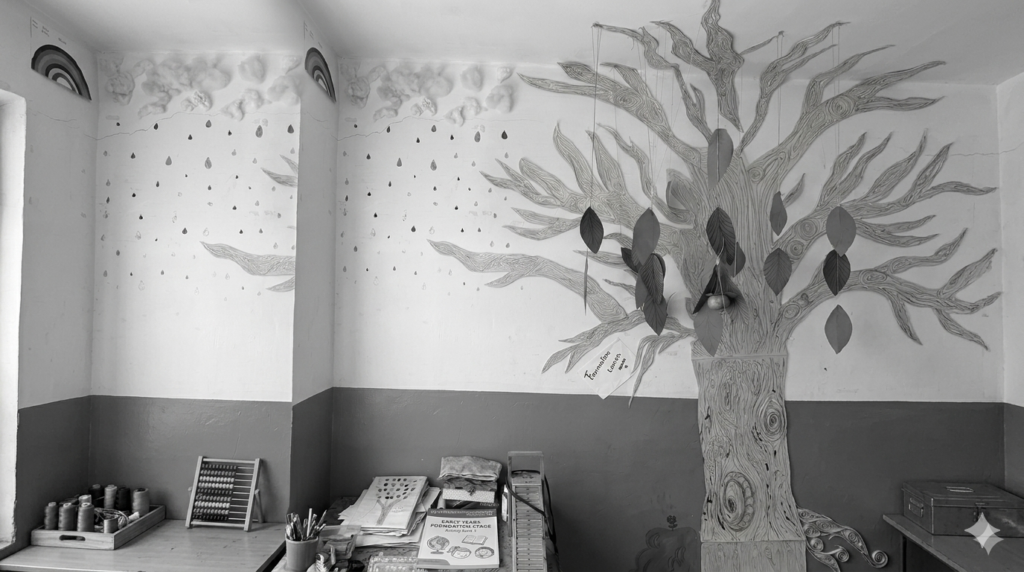
Rebuilding the Emotional Architecture of Learning
We introduced guided reflection, moments of silence, and structured emotional expression into classrooms. Teachers began to observe not only academic progress, but behavioural patterns, emotional triggers, and withdrawal signs. These became deep learning moments for educators as well.
Conversations shifted from:
“Why is this child not performing?”
to
“What is this child carrying?”
Psychomotricity sessions were introduced for children—helping them reconnect with their bodies, movement, and emotional regulation through structured physical expression.
Parenting sessions became essential. In many cases, parents themselves had grown up in the same cycle of disruption. They were not just raising children; they were navigating inherited uncertainty.
What emerged was not a school in the traditional sense. It was an ecosystem.
The “Fracture Team”
One of the most powerful moments came from the teachers themselves.
They named their core group the “Fracture Team.”
Because that is what they were doing—not breaking systems for destruction, but fracturing outdated structures to allow something new to emerge. A glocal model began to form—deeply rooted in local reality, yet connected to global pedagogy. And then, inevitably, the challenges intensified.
Teaching Through Shutdowns and Silence
In Kashmir, the academic calendar is not only shaped by pedagogy, but by curfews, internet shutdowns, and periods of uncertainty. There were months when schools closed without warning. And yet, something remarkable happened. Teachers refused to let learning stop.
They became carriers of continuity.
They risked their own safety to deliver learning materials to students. They created activities without electricity, without stable resources, sometimes without heating in classrooms. They used cellotape to laminate materials. They reinvented teaching daily, not out of abundance—but out of lack.
And paradoxically, it was this lack that became a source of extraordinary creativity.Because when systems are incomplete, human ingenuity takes over.
Love as an Educational Intervention
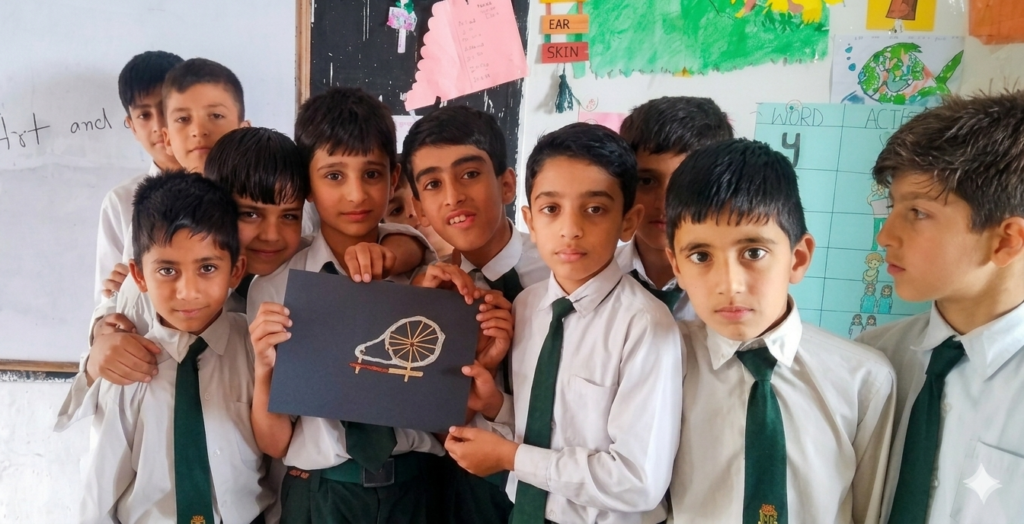
In such contexts, education is often reduced to survival outcomes. But what we discovered was more fundamental: Children do not only need instruction. They need presence.
Empathy. Consistency. Emotional containment. And yes—love. A word often minimized in institutional language, but profoundly necessary in spaces where children have experienced repeated separation—from school, from routine, from safety itself.
Teachers were no longer just educators. They became anchors.
A Mission That Became Real
What began as a vision—to introduce the Cambridge curriculum in Jammu and Kashmir—evolved into something far greater than academic reform.
It became a redefinition of what education can be in fragile contexts.
Not rigid. Not imported. Not imposed. But adapted, embodied, and lived.
Today, what once seemed impossible has become a functioning reality: a Cambridge-aligned learning environment built in one of the most complex educational landscapes in the world.
But perhaps the greatest outcome is not the curriculum itself.
It is this:
A generation of teachers who believe they can rebuild systems.
A generation of children who are slowly learning that learning can feel safe.
And a valley that, despite its fractures, continues to create, adapt, and endure.
Closing Reflection
As someone who came from Brussels—an entirely different world of educational structure and stability—what I learned in Kashmir is simple, but profound:
In places of scarcity, education becomes humanity in its rawest form.
And where systems are broken, people do not just teach.They rebuild.
By
Yasmina Ben m’lah
Co-founder Roots

1 Comment
ExoWatts
Great content! Keep up the good work!