

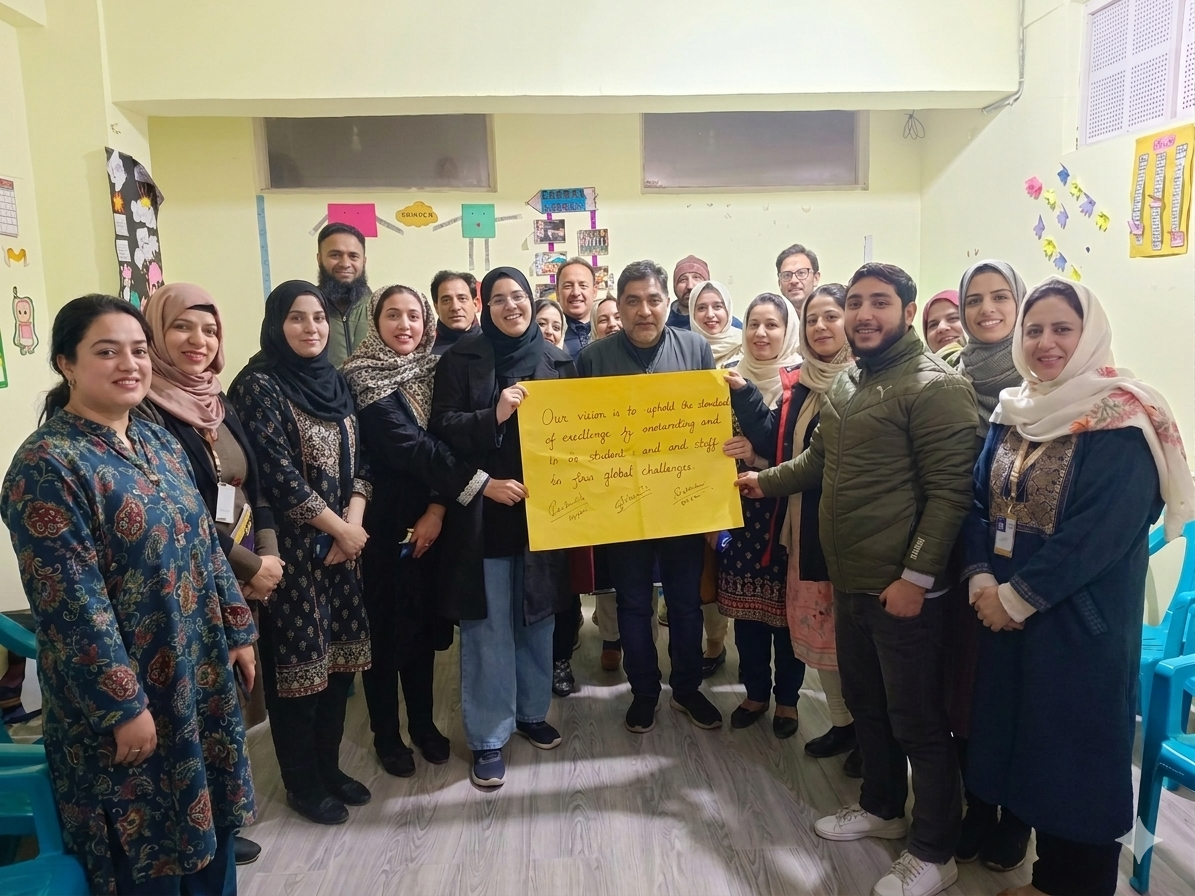
A leadership transformation story from Kashmir Harvard Educational Institute
Client: Kashmir Harvard Educational Institute, Srinagar, J&K
Engagement: Leadership Training Programme — December 2023 to February 2025
Delivered: 32 hrs group training · 24 hrs one-on-one mentoring · 5 trainers
Services: Leadership Coaching · Systems Design · Policy Development · Mentoring
THE SCHOOL
A name that carried a dream.
Beside the waters of Dal Lake in the heart of Srinagar, Kashmir Harvard Educational Institute opened its doors in the 1990s with a name that announced its ambitions before a single lesson had been taught. It was not a modest name. It was a declaration — that children in this valley deserved the very best, that excellence was not reserved for elsewhere, and that one founder’s vision could be the beginning of something lasting.
Decades passed. The school grew — accumulating students, alumni, legacy, and history. What it had not yet built, as new schools multiplied across the valley and the educational landscape shifted dramatically around it, was a leadership structure that could carry its vision forward. The scaffolding that had served the school in its founding years had not kept pace with the institution it was trying to become.
THE CHALLENGE
When a legacy outgrows its scaffolding.
Great institutions are often built in the image of their founders — the values, the culture, the energy. The challenge arrives quietly when the institution needs to grow into something that can sustain itself: when informal authority needs to become shared leadership, and when relationships need to become systems.
At Kashmir Harvard, this was the work that needed doing. Over time, the structures that hold a school together — clear roles, documented policies, defined accountability — had not grown at the same pace as the school itself. Leadership operated more through institutional memory and trust than through process and shared practice. The school had a clear and noble mission. What it needed was the structural capacity to live it consistently, at every level.
The mission was never in question. What needed building was the leadership beneath it — a team that could steer together, grounded in systems rather than sentiment.
THE PROGRAMME
Thirty-two hours of group work. Twenty-four hours of something deeper.
The Leadership Training Programme ran across one year, delivered through 32 hours of group sessions and 24 hours of individual mentoring — facilitated by two international and three national trainers. The programme was designed to work on two tracks simultaneously: building collective leadership capacity across the team, while investing deeply in the one-on-one development of a key leader on the ground.
Group sessions moved through topics including Vision and Mission Integration, Data-Driven Leadership, and System Set-Up — each module connecting the school’s stated purpose to the everyday decisions its leaders make. Alongside the group work, individual mentoring ran in parallel, focused on translating learning into practice: how to manage people, build systems, and lead with both clarity and care.
The programme began with 16 leaders. What happened next was not planned — but it was clarifying.
THE TURNING POINT
The quiet ones. The ones who stayed.
Not everyone who begins a journey of change is ready to complete it. As the programme progressed, some members of the leadership team withdrew — the discomfort of growth, for some, outweighing the pull of it. The room grew smaller. But what remained was more real.
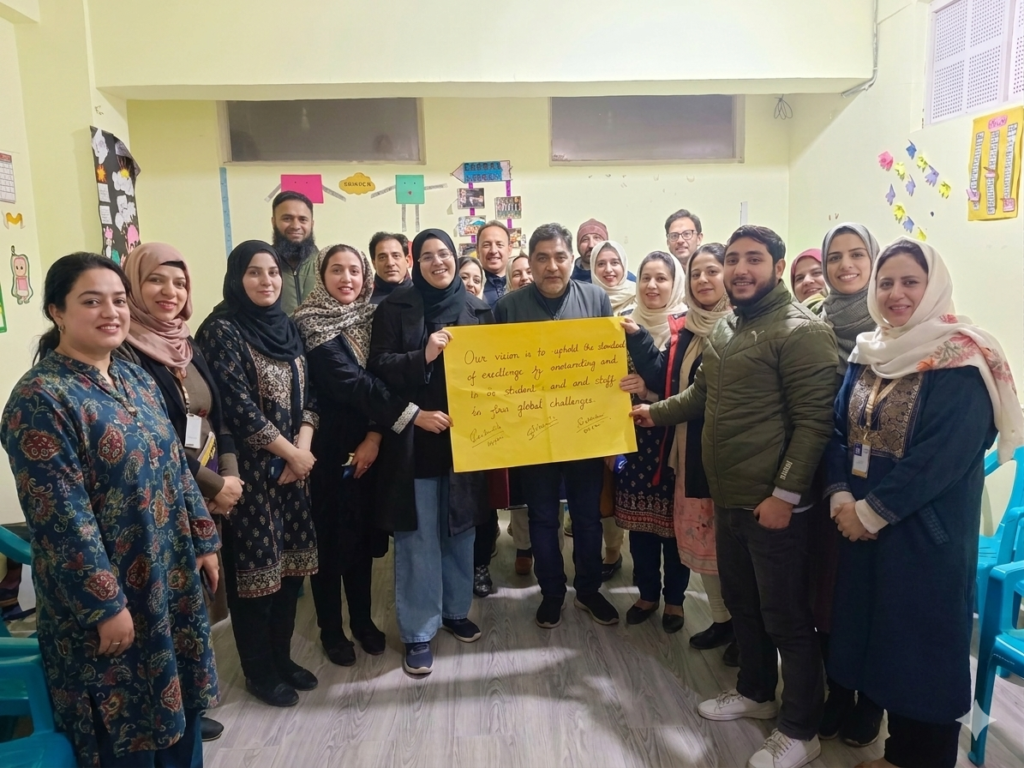
A small group of leaders — quiet, contrary to the noise — formed a circle of learning, persistence, and growth, even in the eye of the storm. While others debated or departed, they absorbed, implemented, and built. Session by session, they were translating awareness into action: drafting policies, mapping processes, defining roles. It was in this group, and in the deep individual mentoring that ran alongside it, that the most meaningful transformation took shape.
It was not the loudest voices that moved the institution forward. It was the persistent ones — the ones who stayed in the work when the work became difficult.
What the individual mentoring revealed, and what we came to believe most deeply, is that a change agent on the ground is what matters most. Not a programme. Not a framework. A person — or a small group of people — who carries the learning forward long after the trainers have left the room.
WHAT WAS BUILT
Six deliverables. One school with a new language.
By the close of the programme, the work had moved from conversation to documentation — from awareness to architecture. The school received a set of foundational governance tools that had never existed before:
19 draft policies compiled into the Kashmir Harvard School Handbook
1 Hierarchy Chart giving every role a clear position and reporting line
6 sets of Job Descriptions defining expectations across leadership positions
Alongside these, Draft Standard Operating Procedures and a Process Map for workflow efficiency gave the institution a written voice where previously only informal practice had spoken. These are not administrative formalities. They are the architecture of a school learning to hold itself accountable.
THE OUTCOME
A mindset shift set in motion.
The small team of leaders who stayed — quiet, contrary to the herd that began the training — continue to work inside the school, building with awareness, cancelling noise. They are not waiting for the transformation to be declared complete. They know it isn’t, and they are at peace with that. What has been set in motion is not a fixed outcome but a learning journey — a mindset shift that continues to deepen, session by session, decision by decision, document by document.
The transformation is a work in progress. And that is precisely what makes it real. What was handed to Kashmir Harvard at the end of this programme was not a finished institution but a living one — with the tools, the people, and the awareness to keep moving forward.
Change is not always visible. But the human lives you impact, the relationships that stand, the people who toil on — those tell the real story. A story of persistence.
WHAT THIS MEANS
One school. A pattern worth naming.
Kashmir Harvard’s story is particular to its place and its people. But the challenge it faced — the gap between institutional legacy and leadership readiness, between a founder’s vision and the systems needed to carry it — is not unique to one school beside the Dal Lake. It is a familiar story in education systems everywhere that grow faster than their governance structures.
What this programme affirmed is that sustainable change begins not with restructuring from the outside, but with building the internal capacity of the people inside. When that capacity finds a home — in a small group who choose to stay, to learn, to implement — the institution moves. Quietly. Persistently. Forwards.
That is where change takes root.